19 April 2017

Colorado passes compromise bill on construction defects

After four failed attempts, Colorado legislators have finally reached a compromise on construction defect legislation.

This afternoon, HB17-1279 gained unanimous approval from the House Committee on State, Veterans, and Military Affairs. The bill is expected to pass both chambers easily and be signed into law by Governor John Hickenlooper.


Attorney Suzanne Leff speaks to the media about HB17-1279, flanked by Senator Jack Tate, Representatives Alec Garnett, Cole Wist, and Lori Saine, and Governor John Hickenlooper.

Proponents say that a bill is needed spur more condominium construction in the state. They contend that homebuilders have been reluctant to construct multifamily projects in recent years based on a perceived fear that small groups of homeowners can file lawsuits in the name of their community associations without adequate the consent of other members. A 2013 study found that quality control and insurance costs only reduce homebuilder profits by a small amount, but concerns about litigation have nevertheless prompted some construction professionals to focus on constructing apartments and other products.

19 December 2016

Electoral College convenes under protest as Colorado Secretary of State rewrites oath of office

At 11:35 am this morning, Colorado presidential electors Polly Baca and Robert Nemanich convinced state court judge Elizabeth Starrs to prohibit Colorado’s Republican Secretary of State, Wayne Williams, from changing the oath of office for this year’s presidential election. During a merits hearing last week, cross-examination revealed that Williams’s office had drafted a new oath for 2016, apparently to discourage any Democrats from defecting from Hillary Clinton to support John Kasich or other alternatives to Donald Trump. Judge Starrs ruled that this was improper and ordered Williams to administer the standard oath. The victory was short-lived, however, as Williams immediately adopted a temporary election rule permitting him to reuse the new oath at noon, despite the court’s ruling moments before. As authority for his rebuke of the court’s order, Williams cited his right to suspend notice and rulemaking procedures to ensure that state elections run smoothly.

Judge Starrs declined to grant the electors further relief when the parties telephoned the courthouse from the governor’s chambers at the state capitol, despite the electors’ argument that Williams had failed to demonstrate that changing the oath was “imperatively necessary,” as required to suspend the notice and rulemaking requirements of Colorado’s State Administrative Procedure Act. The electors eventually agreed to signed the new oath “under duress.” Williams had previously said they would be removed from their positions if they did not swear their allegiance under the modified oath.

This is the first time such an oath is believed to have been administered in Colorado. Baca said that, in her previous experience as an elector in 2008 and 2012, the Secretary had used the standard oath of office. The standard oath requires an elector to support the state and federal constitutions and faithfully performing the duties of the office, but it stops short of telling electors how to actually vote in the federal election for president. A state statute, C.R.S. § 1-4-304(5), purports to bind the electors’ vote to the winner of the general election, but many have suggested that this statute violates the United States Constitution.

Baca and others said that they were coerced into signing the new oath. In a scene that felt like it could have been lifted from a fascist propaganda film, the electors reluctantly raised their right hands and took the modified oath. One elector, Michael Baca (no relation to Polly) apparently reconsidered after signing his oath. Mr. Baca, dressed in a bright yellow Bernie Sanders T-shirt, cast his vote for Kasich, which immediately prompted Williams to remove him in favor of an alternate willing to vote for Hillary. The large crowd that had assembled disapproved and began shouting for Williams himself to resign.

Whether the Secretary’s actions were constitutional remains unclear. The federal courts declined to enter an injunction prior to today’s meeting of the Electoral College, but they are still expected to decide in the future whether the states can treat presidential electors as performing the purely ministerial task of ratifying election results, or whether they must remain free to fulfill their constitutional duty to deliberate, investigate, and choose a qualified candidate for office, as Alexander Hamilton intended.

Late Friday, a federal appeals court had ruled that it was unlikely that Williams or the state had authority to remove presidential electors after the Electoral College convened, reasoning that the electors would be subject to federal law once appointed by the state. Nevertheless, that is exactly what transpired today after Mr. Baca voted for Kasich. Mr. Baca asked for legal advice as the Secretary sought to remove him, and his attorney, Jason Wesoky, attempted to explain this issue before Williams asked him to step away.

Jesse Witt of the The Witt Law Firm has represented Polly Baca and Robert Nemanich in the state courts. Wesoky of Darling Milligan Horowitz PC is representing them in their ongoing federal action.

Several hours after Colorado voted, electors in Texas delivered the presidency to Donald Trump. Two Texas electors defected, one supporting Ron Paul and the other joining Michael Baca to cast a vote for Kasich

16 December 2016

Colorado high court declines to hear Hamilton Electors’ appeal

Late this afternoon, the Colorado Supreme Court declined to exercise jurisdiction over the appeal by presidential electors Polly Baca and Robert Nemanich. These means that, absent intervention by the federal courts, the Colorado Secretary of State will be able to remove these electors if they vote for a candidate other than Hillary Clinton or Timothy Kaine when the Electoral College convenes on Monday in Denver.

Baca and Nemanich had previously stated their belief that federal law requires members of the Electoral College to meet, deliberate, and investigate before choosing a candidate for president. These duties are set forth in the writings of Alexander Hamilton and reflected in Article II and Amendment XII of the Constitution. Although Baca and Nemanich each indicated their support for Hillary Clinton, they also expressed a willingness to consider choosing another candidate if the opportunity arose to join with Republican electors in other states to support a bipartisan alternative to Donald Trump.

Today’s ruling was limited to an interpretation of state election law. An emergency appeal is still ongoing in the federal Tenth Circuit, where Baca and Nemanich have asked a three-judge panel to suspend the law altogether because it violates the Constitution. Earlier this morning, Trump’s lawyers filed a brief in that case arguing that Baca and Nemanich cannot be allowed to vote for another candidate, in part because it could disrupt his otherwise orderly transition to power.

The decision not to decline the electors’ appeal today does not create legal precedent, so the issue could arise again in future elections.

The Witt Law Firm’s Jesse Witt has represented Baca and Nemanich in the state courts. Jason Wesoky of Darling Milligan Horowitz PC has represented them in the federal actions.

15 December 2016

Update on Hamilton Electors lawsuit

This afternoon, Presidential Electors Polly Baca and Robert Nemanich filed an emergency appeal with the Colorado Supreme Court, asking the seven justices to vacate a district court order that requires them to vote for Hillary Clinton when the Electoral College convenes at noon on Monday.

In their petition, Baca and Nemanich argue that the state court lacked jurisdiction to enter injunctive relief against presidential electors who are tasked with performing duties under federal law. They further argue that the court committed legal error by deeming the act of voting for a different candidate to be a “refusal to act,” and by adding remedies to the election code that state legislators never intended.

Baca and Nemanich asked the court to set an expedited briefing schedule and issue a ruling before the Electoral College meets.

Jesse Witt of The Witt Law Firm is representing Baca and Nemanich in their supreme court appeal.

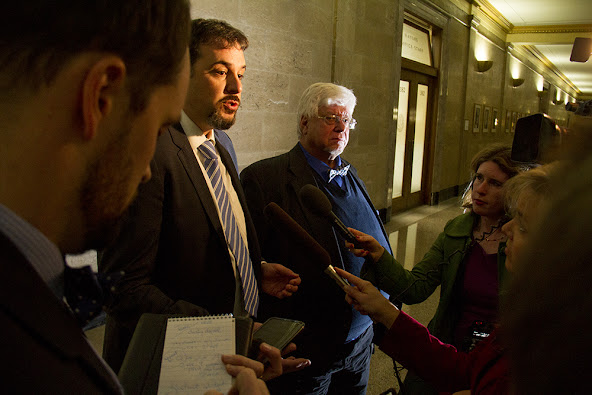
Jesse Witt, representing elector Robert Nemanich, speaks to press outside of the courtroom. (Kevin J. Beaty/Denverite)