21 September 2023

Parties may contract to extend the statute of limitations for construction defects

Contracting parties may extend the statute of limitations for construction defect claims, according to a new opinion announced today by the Colorado Court of Appeals.

Construction defect claims in Colorado are subject to the Construction Defect Action Reform Act (CDARA), a series of statutes first enacted in 2001 and modified at various times since then.1 In 2007, the legislature passed the Homeowner Protection Act, which amended CDARA to codify and protect certain homeowner rights, including a prohibition on any contracts that purport to shorten the statute of limitations period.2

In South Conejos School District RE-10 v. Wold Architects Inc.,3 the court addressed the flipside of this issue: If parties cannot shorten the statute of limitations, does that also mean they also cannot lengthen it? In other words, the court considered “whether a contract provision is enforceable if it provides a more generous claim accrual standard” than the statute?4

The court first noted that the statute requires claims be asserted within two years of the date the property owner first discovers the “physical manifestation” of a construction defect.5 Prior decisions had interpreted this language to mean that a cause of action could accrue upon discovery of property damage, even if the owner was unaware of the underlying defect that caused the loss.6 In South Conejos School District, however, the parties had agreed that claims would not accrue until a defect had been “Discovered,” which the contract further defined to mean the owner’s “detection and knowledge” of the defect, an event that could potentially occur at a much later date.7 Addressing a question of law via interlocutory appeal, the court ruled that this contract language was enforceable, and that sophisticated parties could agree to extend the statute of limitations period.

The court discussed freedom of contract principles, and it emphasized that contracts are generally enforceable unless they violate statutory prohibitions or public policy.8 The court acknowledged that CDARA prohibits shortening the limitations period, but the court concluded that this did not prevent parties from lengthening the period.9 This is a logical distinction, since it would make little sense to invoke a statute designed to protect property owners as grounds to erase additional protections that an owner had negotiated with a construction professional.

The court discussed its earlier decision in Highline Village Associates v. Hersh Companies, which had identified a similar issue.10 Oddly, the court did not mention the Colorado Supreme Court’s later holding that affirmed and reversed the Hersh opinion in part.11 In the latter ruling, the supreme court held that a builder could be liable for breach of warranty even after the construction defect statute of limitations period had expired, insofar as claims for “breach of a subsequent contractual duty to repair or replace rather than recovery for a deficiency in the original work, they do not fall within the class of actions governed by section.”12

Although the supreme courtHersh opinion was decided prior to enactment of the relevant CDARA provisions, its logic is consistent with the recent interpretation of South Conejos School District. Both cases recognize that a builder remains liable for repairing construction defects during the time period set forth in any written warranty or contract. CDARA sets a minimum period of two years for negligence claims, but nothing in the act prevents parties from negotiating remedies of longer duration.


C.R.S. §§ 13-20-801 to -807. 
2 C.R.S. § 13-20-807(7)(a). 
3 2023 COA 85. 
4 Id. ¶ 15. 
5 Id. ¶ 21, citing C.R.S. § 13-80-104(1)(b)(I). 
6 See Highline Vill. Assocs. v. Hersh Cos., 996 P.2d 250, 253 (Colo. App. 1999); see also United Fire Group ex rel. Metamorphosis Salon v. Powers Electric, Inc., 240 P.3d 569 (Colo. App. 2010). 
7 2023 COA 85 ¶ 20. 
8 Id. ¶¶ 24-34 
9 Id. 
10 Id. ¶ 6, citing Highline Vill., 996 P.2d at 255. 
11 30 P.3d 221 (Colo. 2001). 
12 Id. at 226.

25 January 2023

ABA profiles me as construction mediator

I was honored this month when the American Bar Association's Forum on Construction Law profiled me as one of their roster of neutral mediators and arbitrators. Please click the link below to read more!

https://abaconstructionforumdivision1.blogspot.com/2023/01/meet-d1s-neutrals-series-jessie-howard.html 


02 December 2022

Eleventh Circuit dismisses latest Trump filing

Yesterday, the Eleventh Circuit issued a blistering opinion ordering the dismissal of Donald Trump's latest legal absurdity.
 
Chief Judge William H. Pryor Jr., a George W. Bush appointee and former prosecutor, wrote the unanimous opinion, which held that the district court judge lacked jurisdiction to interfere with an ongoing criminal investigation. Because a federal magistrate had already found probable cause to search Trump's home before approving the warrant, there was no further role for the federal courts to play, and the district court erred by entertaining Trump's request to have a special master appointed.

The panel emphasized that allowing such an action would open up floodgates of lawsuits by every person who was the subject of a search warrant. Relying on established precedent of Richey v. Smith, 515 F.2d 1239 (5th Cir. 1975), the court summarized:

Anyone could make these arguments. And accepting them would upend Richey, requiring federal courts to oversee routine criminal investigations beyond their constitutionally ascribed role of approving a search warrant based on a showing of probable cause. Our precedents do not allow this, and neither does our constitutional structure.

The panel lastly considered whether to create a special new rule for former presidents under criminal investigation. The court declined, emphasizing that creation of a "special exception here would defy our Nation's foundational principle that our law applies 'to all, without regard to numbers, wealth, or rank,'"  quoting State of Georgia v. Brailsford, 3 U.S. (3 Dall.) 1, 4 (1794).

The Full opinion is available here: https://media.ca11.uscourts.gov/.../pub/files/202213005.pdf

Credit to Above the Law for their initial write-up.

07 November 2022

ABA clarifies that "reply all" emails do not violate rule against contacting represented parties

In a useful model opinion published last week, the American Bar Association has provided some clarification about whether it is unethical to hit "reply all" when responding to an email from a lawyer who has copied his or her client when messaging opposing counsel. The ABA suggests that copying a client on an email to the other side creates implied consent for one's adversary to reply to all recipients, even if direct communications might otherwise be prohibited.

In most jurisdictions, it is unethical for a lawyer to contact an opposing party who has counsel; such communications must be sent to the opposing party's attorney to avoid undue influence and circumvention of the legal protections of representation. Questions arise, however, when a lawyer sends an email to opposing counsel and includes his or her client (i.e. the sending lawyer's client) on the cc line. Is it permissible to reply all? Given how much we love to grandstand and pontificate in our profession, many lawyers always reply all to garner the biggest audience, but is that unethical? Conversely, is it practical to suggest that a lawyer receiving an email has a duty to comb through a (sometimes lengthy) list of email recipients to sort out who might be represented parties, perhaps guessing at who might own unfamiliar domains and email addresses? 

In my own practice, I have seen three examples of responses to such emails. First, many will hit reply all out of habit, without ever noticing that adverse clients might be included. Second, some will take the time to parse out non-attorneys from the cc line and limit their responses to the original sender or other counsel. Third, a few will deliberately take the opportunity to bypass the wall of legal representation and speak directly to an adverse client, notwithstanding the possible ethical violation.

Under the ABA's new opinion, any of these options would be permissible. If an attorney wishes to avoid opening up his or her client to receiving emails from an opposing lawyer, then the attorney should take care to always email his or her client separately, not on the cc line of a message to the other side. While it may be tempting to copy one's own client when arguing to the other side, such emails may constitute implied consent for the opposition to reply back directly to the client.

While some of this risk may be mitigated by leaving clients in the blind copy (bcc) line, that is not ideal either. Copying clients on external emails is almost always a bad idea. Even if the opposing lawyer declines to reply all, and even if the client is hidden on the bcc line, the risk is always present that the client will accidentally reply all, which presents a far worse problem insofar as a client sending private comments to opposing counsel may constitute waiver of attorney-client privilege. It is a much better practice to wait until after an email has been sent, then forward a copy to the client in a separate thread.

The opinion--which is not binding but may have persuasive force--also notes that, while consent can be implied, this is not absolute. If for example, a lawyer advises the opposition that copying a client is not intended as permission to reply all, that would defeat the implied consent. Such advisement should be clear, and merely including a boilerplate disclaimer in an email signature may not suffice. I cannot imagine many situations in which one would want to copy a client while also disclaiming consent to reply all, though this could arise where parties are seeking digital signatures using software (e.g., DocuSign, AdobeSign, etc.) that must be sent directly to the document signatories in order to verify their identities. In most cases, so long as there is no technical requirement to copy the client directly on an email, it would remain preferable to email the clients via a separate thread.

The full text is available at the following link to Formal Opinion 503

ABA members can also find further discussion of the new opinion online from the ABA Journal.

Email graphic from Shutterstock, via abajournal.com


17 August 2022

Massive changes coming to Colorado homeowner association law

I have another new article up at Frascona, this one dealing with the major overhaul of CCIOA's enforcement provisions that the Colorado General Assembly passed this session. Karen Radakovich and I put together this summary of the key provisions taking effect this month.

Writing this, I was reminded of the April Fools post I wrote ten years ago. This one is for real, though, and it remains to be seen how homeowners associations will handle these changes. 

Click here to read the full text on the Frascona website.


08 August 2022

New article on credit card surcharges in Colorado

I recently authored an article on credit card surcharges in Colorado, which had been one of the few states to prohibit such fees. Under a 2021 law that just took effect, merchants may now charge customers for the privilege of using cards, though it may not be the best idea. 

Click here to read the full article on the Frascona website.

Credit cards

03 August 2022

Bringing back the blog

So my venerable old website crashed a few months ago, but between a couple of backup files and the resources at archive.org, I was able to salvage my old resources and upload them here. I don't post very often anymore, but I figured I might as well put this content back online in case it are useful to anyone. I think I fixed the broken links, but no promises. Enjoy!

28 February 2022

Federal appeals court grants relief to refugee fleeing torture in Cameroon

Last month, the Tenth Circuit in Denver issued a key opinion granting my client's petition for review of a Board of Immigration Appeals order in Takwi v. Garland, 22 F.4th 1180 (10th Cir. 2022).

The Petitioner is a member of the Anglophone community in Cameroon, which faces violent repression and persecution by the Francophone government. He was arrested and tortured by the Cameroonian military on two occasions, after being targeted based on his family's association with the Southern Cameroon National Council, a group that advocates against marginalization by the government. He fled for his life in 2018 and sought asylum in the United States. Although he gave credible and consistent testimony through his proceedings, an Immigration Judge (IJ) rejected his application based on perceived inconsistencies between his testimony and a supporting affidavit written by his brother.

03 November 2021

CREJ publishes new article on retainage limits

Today, the Colorado Real Estate Journal published an article I wrote with Lauren Taylor summarizing a new law limiting retainage to 5% on many private construction contracts in Colorado. Click here to read the full text.

The new law follows an unsuccessful effort in 2014 to pass similar legislation. I testified at a hearing back then and blogged about it at the time. I was not involved in the recent legislation.

13 December 2018

Court of appeals rules that HOA lien is not spurious, despite claim that annexation was invalid

Today, the Colorado Court of Appeals reversed a order that had deemed a homeowner association’s lien to be spurious.

The case arose after a developer approved a property owner’s application to annex additional real estate to a community in 1999. Several years later, the developer repurchased the property through a foreclosure sale. Despite its prior approval of the annexation, the developer refused to pay community maintenance assessments, which prompted the association to record a lien under its covenants and a statutory provision of the Colorado Common Interest Ownership Act (CCIOA).

The parties remained in a standoff until 2016, when the Colorado Supreme Court announced two decisions that adopted a stricter standard for annexing property into communities subject to CCIOA.

12 December 2018

Big news from The Witt Law Firm

2018 was a great year for The Witt Law Firm, and 2019 is bringing big changes.

I am excited to announce that I have decided to accept an Of Counsel position with Frascona, Joiner, Goodman and Greenstein. Founded in 1974, the firm has grown to become Colorado's preeminent real estate and business law firm, and its outstanding team of lawyers and paralegals will be an excellent complement to my construction law and litigation practice.

To all my clients and colleagues, I wish you the happiest of holidays. I look forward to working with you in the new year at the new firm!

-Jesse

01 September 2017

Colorado's new construction defect law takes effect in September: What you need to know.

 Colorado’s new construction defect law officially takes effect this month. Although HB 17-1279 was passed in May, the statutory text provides that it only applies “with respect to events and circumstances occurring on or after September 1, 2017.” With that date now upon us, practitioners should be mindful of the law’s new requirements.

The law applies to any lawsuit wherein a homeowner association files a construction defect action on behalf of two or more of its members. “Construction defect action” is defined broadly to include any claims against construction professionals relating to deficiencies in design or construction of real property. Before an association may commence such an action, its board must follow several steps.

05 June 2017

Colorado Supreme Court rules that developers can retain perpetual control over HOA covenants

The Colorado Supreme Court ruled today that developers can retain control over community covenants in perpetuity by recording a covenant that requires declarant consent to any amendments. Although the Colorado Common Interest Ownership Act (CCIOA) states that such controls should be void, the court nevertheless ruled that a declarant may veto amendments that alter the dispute resolution procedures for construction defect actions at any time.

The case of Vallagio at Inverness Residential Condominium Ass’n v. Metropolitan Homes, Inc., 395 P.3d 788, 2017 CO 69, arose when the community’s members discovered widespread construction defects.

19 April 2017

Colorado passes compromise bill on construction defects

After four failed attempts, Colorado legislators have finally reached a compromise on construction defect legislation.

This afternoon, HB17-1279 gained unanimous approval from the House Committee on State, Veterans, and Military Affairs. The bill is expected to pass both chambers easily and be signed into law by Governor John Hickenlooper.


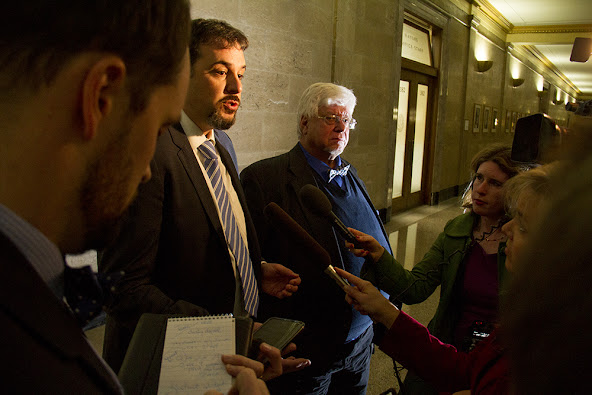
Attorney Suzanne Leff speaks to the media about HB17-1279, flanked by Senator Jack Tate, Representatives Alec Garnett, Cole Wist, and Lori Saine, and Governor John Hickenlooper.

Proponents say that a bill is needed spur more condominium construction in the state. They contend that homebuilders have been reluctant to construct multifamily projects in recent years based on a perceived fear that small groups of homeowners can file lawsuits in the name of their community associations without adequate the consent of other members. A 2013 study found that quality control and insurance costs only reduce homebuilder profits by a small amount, but concerns about litigation have nevertheless prompted some construction professionals to focus on constructing apartments and other products.

19 December 2016

Electoral College convenes under protest as Colorado Secretary of State rewrites oath of office

At 11:35 am this morning, Colorado presidential electors Polly Baca and Robert Nemanich convinced state court judge Elizabeth Starrs to prohibit Colorado’s Republican Secretary of State, Wayne Williams, from changing the oath of office for this year’s presidential election. During a merits hearing last week, cross-examination revealed that Williams’s office had drafted a new oath for 2016, apparently to discourage any Democrats from defecting from Hillary Clinton to support John Kasich or other alternatives to Donald Trump. Judge Starrs ruled that this was improper and ordered Williams to administer the standard oath. The victory was short-lived, however, as Williams immediately adopted a temporary election rule permitting him to reuse the new oath at noon, despite the court’s ruling moments before. As authority for his rebuke of the court’s order, Williams cited his right to suspend notice and rulemaking procedures to ensure that state elections run smoothly.

Judge Starrs declined to grant the electors further relief when the parties telephoned the courthouse from the governor’s chambers at the state capitol, despite the electors’ argument that Williams had failed to demonstrate that changing the oath was “imperatively necessary,” as required to suspend the notice and rulemaking requirements of Colorado’s State Administrative Procedure Act. The electors eventually agreed to signed the new oath “under duress.” Williams had previously said they would be removed from their positions if they did not swear their allegiance under the modified oath.

This is the first time such an oath is believed to have been administered in Colorado. Baca said that, in her previous experience as an elector in 2008 and 2012, the Secretary had used the standard oath of office. The standard oath requires an elector to support the state and federal constitutions and faithfully performing the duties of the office, but it stops short of telling electors how to actually vote in the federal election for president. A state statute, C.R.S. § 1-4-304(5), purports to bind the electors’ vote to the winner of the general election, but many have suggested that this statute violates the United States Constitution.

Baca and others said that they were coerced into signing the new oath. In a scene that felt like it could have been lifted from a fascist propaganda film, the electors reluctantly raised their right hands and took the modified oath. One elector, Michael Baca (no relation to Polly) apparently reconsidered after signing his oath. Mr. Baca, dressed in a bright yellow Bernie Sanders T-shirt, cast his vote for Kasich, which immediately prompted Williams to remove him in favor of an alternate willing to vote for Hillary. The large crowd that had assembled disapproved and began shouting for Williams himself to resign.

Whether the Secretary’s actions were constitutional remains unclear. The federal courts declined to enter an injunction prior to today’s meeting of the Electoral College, but they are still expected to decide in the future whether the states can treat presidential electors as performing the purely ministerial task of ratifying election results, or whether they must remain free to fulfill their constitutional duty to deliberate, investigate, and choose a qualified candidate for office, as Alexander Hamilton intended.

Late Friday, a federal appeals court had ruled that it was unlikely that Williams or the state had authority to remove presidential electors after the Electoral College convened, reasoning that the electors would be subject to federal law once appointed by the state. Nevertheless, that is exactly what transpired today after Mr. Baca voted for Kasich. Mr. Baca asked for legal advice as the Secretary sought to remove him, and his attorney, Jason Wesoky, attempted to explain this issue before Williams asked him to step away.

Jesse Witt of the The Witt Law Firm has represented Polly Baca and Robert Nemanich in the state courts. Wesoky of Darling Milligan Horowitz PC is representing them in their ongoing federal action.

Several hours after Colorado voted, electors in Texas delivered the presidency to Donald Trump. Two Texas electors defected, one supporting Ron Paul and the other joining Michael Baca to cast a vote for Kasich

16 December 2016

Colorado high court declines to hear Hamilton Electors’ appeal

Late this afternoon, the Colorado Supreme Court declined to exercise jurisdiction over the appeal by presidential electors Polly Baca and Robert Nemanich. These means that, absent intervention by the federal courts, the Colorado Secretary of State will be able to remove these electors if they vote for a candidate other than Hillary Clinton or Timothy Kaine when the Electoral College convenes on Monday in Denver.

Baca and Nemanich had previously stated their belief that federal law requires members of the Electoral College to meet, deliberate, and investigate before choosing a candidate for president. These duties are set forth in the writings of Alexander Hamilton and reflected in Article II and Amendment XII of the Constitution. Although Baca and Nemanich each indicated their support for Hillary Clinton, they also expressed a willingness to consider choosing another candidate if the opportunity arose to join with Republican electors in other states to support a bipartisan alternative to Donald Trump.

Today’s ruling was limited to an interpretation of state election law. An emergency appeal is still ongoing in the federal Tenth Circuit, where Baca and Nemanich have asked a three-judge panel to suspend the law altogether because it violates the Constitution. Earlier this morning, Trump’s lawyers filed a brief in that case arguing that Baca and Nemanich cannot be allowed to vote for another candidate, in part because it could disrupt his otherwise orderly transition to power.

The decision not to decline the electors’ appeal today does not create legal precedent, so the issue could arise again in future elections.

The Witt Law Firm’s Jesse Witt has represented Baca and Nemanich in the state courts. Jason Wesoky of Darling Milligan Horowitz PC has represented them in the federal actions.

15 December 2016

Update on Hamilton Electors lawsuit

This afternoon, Presidential Electors Polly Baca and Robert Nemanich filed an emergency appeal with the Colorado Supreme Court, asking the seven justices to vacate a district court order that requires them to vote for Hillary Clinton when the Electoral College convenes at noon on Monday.

In their petition, Baca and Nemanich argue that the state court lacked jurisdiction to enter injunctive relief against presidential electors who are tasked with performing duties under federal law. They further argue that the court committed legal error by deeming the act of voting for a different candidate to be a “refusal to act,” and by adding remedies to the election code that state legislators never intended.

Baca and Nemanich asked the court to set an expedited briefing schedule and issue a ruling before the Electoral College meets.

Jesse Witt of The Witt Law Firm is representing Baca and Nemanich in their supreme court appeal.

Jesse Witt, representing elector Robert Nemanich, speaks to press outside of the courtroom. (Kevin J. Beaty/Denverite)

07 December 2016

A grandmother’s reflections on Pearl Harbor

To commemorate the 75th anniversary of the Pearl Harbor attack, I wanted to share an old letter I found among my grandmother’s papers this past summer, recalling her own memories of that fateful day. –JHW

December 07, 1994

Today is the 53rd Anniversary of Pearl Harbor, the day that has lived in infamy as FDR referred to it on his address to Congress asking for a declaration of War (there was only one dissention, a Miss Rankin, a Senator, I believe from one of the Southern States.) I was sitting in my home in Sweetwater, Texas. It was a Sunday morning, a sort of day off for Howard with only a few chores at the Saddle Horse. When I heard that practically the entire Pacific fleet had been wiped out it was a time of anguish, and a puzzle too—weren’t Japan’s representatives at that same hour negotiating in Washington?

When FDR convened the Congress the next day—or so—I wanted to hear his address on the battery radio. I called Howard in—and along with him a Mr. Chandler who was working there clearing some land and who when I called asked if he could come in and listen to the radio with us. He was a veteran of WWI—had been with the AEF in Europe. So of course, we invited him in. That familiar voice—Magnificent!—of FDR came over the air ways and we—as a country—were plunged immediately into a time of horror and deprivation which we had never known before. Our way of life changed completely. We were never again to know the sweet soft easy existence we were accustomed to—the death march of Bataan, Leyte Gulf, Tarawa, Iwo Jima—all this lay ahead of us in one screaming thrust of War. It led to so much sorrow, so much loss. We would never be the same as we moved on to Hitler’s Germany and all their atrocities—the Holocaust, the Battle of Dunkirk—and all the time an innocence was lost, never to be regained for two American citizens who were forced to become accustomed to world horror as time marched on.

Jo Witt

This letter was written in 1994, a little over a year after my grandfather Howard had passed away. She wrote many letters in those days, wishing she could still speak to him. Jo lived on until the summer of 2001, and I always felt it was merciful that she did died without having to witness the tragedy that befell us that September. 

She appears to have added more text at some later time, discussing the military service of her three brothers, John, Bid, and Sidney. Portions are in a shakier script and accompanied by a note in the margin reading “in this section I was writing in the dark.” I have copied those below.

I do not want to diminish the efforts of those family members who were involved first hand with the Ultimate devotion. My brother John was a Marine. Bid tried to enlist Navy requesting submarine duty. Sidney regretted being still in high school, wanted to drop out of school and enlist, He said “darn it, the war’ll be over before I get in there.”—

Bid did become part of the Service, military that is, and as part of the U.S. Navy was active in the Pacific Zone, aboard the U.S.S. Lowry, a destroyer—active in the Battle of Leyte Gulf, among others. Sidney upon graduating from High School enlisted in the U.S. Air Force + served for 4 years, he was on active duty in England; this was during the “Korean Conflict.”

I don’t know if my grandmother ever intended this letter to be published, but I know that she understood the importance of learning from history. With that in mind, I have reprinted her words here exactly as she wrote them. Now, perhaps more than ever, we need to remember the sacrifices that prior generations made for us.

03 November 2016

Appeals court affirms carrier’s duty to pay costs taxed against insured in construction defect suit

One of the key reasons for builders to maintain liability insurance is to cover the cost of hiring defense counsel and paying litigation costs in the event of a construction defect lawsuit. If a builder loses a lawsuit, it will typically be responsible for paying the plaintiff’s litigation costs. Today, the Colorado Court of Appeals clarified that the “supplementary payments” section of a standard Commercial General Liability (CGL) insurance policy covers such costs, even if the carrier has reserved the right to dispute whether it has a duty to indemnify the actual damages awarded.

This may seem counter-intuitive, insofar as a carrier may end up paying costs even if it does not cover the underlying loss, but the court’s decision is consistent with the plain language of the CGL form that most carriers use. Furthermore, while the court focused on the plain contract language without regard to public policy concerns, the decision may be seen to recognize the role that insurance defense counsel plays in the costs of litigation. If an insurance defense firm eschews offers of settlement and engages in aggressive discovery, for example, it may increase the insured’s chances of winning while also increasing the risk that the insured will face a larger cost bill at the end of the case. In such a scenario, it is fair and equitable to require the carrier to pay costs, regardless of any determination of coverage.

The opinion in Mt. Hawley Insurance Co. v. Casson Duncan Construction, Inc.2016COA164, is available on the court’s website.

01 September 2016

National demand increases for apartments, refuting calls for construction defect immunity in Colorado

For the last four years, the homebuilders’ lobby has been aggressively pushing the idea that consumer protection laws are stifling condominium construction in Colorado. The lobbyists claim that the fear of liability for construction defects has forced many local developers to build apartments instead of condominiums. They have dismissed the notions that the shift to apartments merely reflects supply and demand, or that modern families might actually prefer to rent rather than buy. To support this theory, they have touted high condominium sales in other states. A new story from NPR’s Here & Now refutes this claim, however.

Contrary to what the lobbyists have been saying, data now confirm that large numbers of Americans prefer to rent, not buy, their homes. NPR reported today that home ownership in the U.S. fell to its lowest rate since 1965, while the share of U.S. households who rent is nearing a 50-year high. This trend appears nationwide and can hardly be blamed on consumer protection laws in Colorado.

This boom in apartments, furthermore, has not been bad for the construction industry. On the contrary, the report notes that demand for apartments is fueling a “construction resurgence,” and H.U.D. recently announced a new high in nationwide housing starts. In a recent interview, the chairman of the National Association of Home Builders credited apartment construction for this rise: “New household formations are upping the demand for rental housing, which in turn is spurring the growth of multifamily production…. Meanwhile, single-family housing continues to hold firm.”

Colorado legislators should remember these statistics next session, when the homebuilders make their annual pilgrimage to the Capitol to complain about how the state’s consumer protection laws are killing the construction industry. Just because builders are profiting from record-high demand for apartments does not mean that lawmakers should strip away consumer protections for those who choose to buy new homes.